Sample Rate Conversion Results
 dBpoweramp A suite of premium audio software for Windows and macOS, primarily known for its secure CD ripping and comprehensive audio file conversion capabilities dBpoweramp A suite of premium audio software for Windows and macOS, primarily known for its secure CD ripping and comprehensive audio file conversion capabilities
ARDFTSRC Arbitrary Sample Rate Discrete Fourier Transform Sample Rate Converter. Sophisticated mathematical approach based on the Discrete Fourier Transform (DFT) to achieve highly accurate sample rate conversions
|  Adobe Audition Digital audio workstation featuring both waveform editing and multi-track mixing Adobe Audition Digital audio workstation featuring both waveform editing and multi-track mixing
|
| Overall Balanced Quality 99.70 % | Overall Balanced Quality 71.69 % |
Bit depth, whilst a SRC might accept 64 bit floating point, internally it might process at a much lower bit depth, this test checks different bit depths:
 16 bit 24 bit 32 bit 32 bit float 64 bit float 16 bit 24 bit 32 bit 32 bit float 64 bit float | 16 bit 24 bit 32 bit 32 bit float  64 bit float 64 bit float |
SRC routines can introduce a delay at the start:
| Calculated delay 0 samples Quality Score 100% | Calculated delay 0 samples Quality Score 100% |
Spectrogram of a sweep 1 to 22 kHz
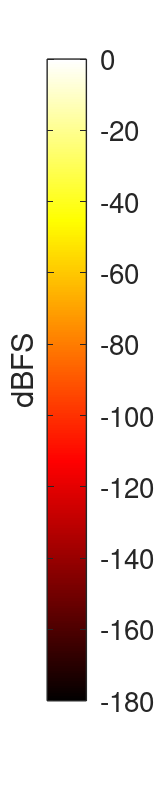
A sine sweep from 1 to 22 kHz the ideal plot is a single strong red line. Issues with aliasing effects or filter cutoff would show as extra lines. Noise would appear as dots across the plot (instead of a black background). [96 kHz source resampled to 44 kHz]
Spectrogram of a sweep 1 to 22 kHz (extended)
The source signal included a sine sweep all the way up to 44 kHz, however when downsampled to 44 kHz the highest frequency which can be represented is 22 kHz. This plot would show if the sine above 22 kHz is filtering down into the plot, there should be nothing plotted after 10 seconds. [96 kHz source resampled to 44 kHz]
Aliasing
A 23 kHz sine at -4 dBFS with a white noise floor of -150 dBFS over 30 seconds. The ideal plot is a continuous line touching the -150dB line, many SRC routines engage a gradual filter at 20 kHz which would be visible on this plot. [96 kHz source resampled to 44 kHz]
Quality Score 100%(click image to view full size)  |
| Quality Score 50%(click image to view full size)  |
|
Nyquist Filter
Zoomed on nyquist frequency (22.050 kHz), the bandwidth of the SRC is displayed. A SRC with 100% bandwidth, that is full freqency preservation would be a straight line of noise. [96 kHz source resampled to 44 kHz]
Quality Score 99.31%(click image to view full size)  |
| Quality Score 99.56%(click image to view full size)  |
|
Intermodulation Harmonic Distortion
Two sine waves one at 64.59 Hz, -6 dBFS and the second at 6998 kHz, -18.0412 dBFS, which equals quarter the amplitude of the first sine. This test will highligh aliasing and dynamic range of processing. It will also show if dither has been applied, look for high frequency signals on the plot. [96 kHz source resampled to 44 kHz]
(click image to view full size)  |
| (click image to view full size)  |
|
Intermodulation Harmonic Distortion (difference)
The difference between the ideal and measured signals from the Intermodulation Harmonic Distortion test. [96 kHz source resampled to 44 kHz]
Quality Score 100%(click image to view full size)  |
| Quality Score 43.74%(click image to view full size)  |
|
Impulse Frequency
A frequency response displaying leakage beyond the ideal frequency response.
Impulses are at sample positions n so that {n mod 320} is a permutation of {0, 1, 2, . . . , 319}. All fractional differences in sample positions between input and output signal are addressed exactly once. The output signal is upsampled to 14.112 MHz and the impulse responses are added to obtain a high resolution impulse response. [96 kHz source resampled to 44 kHz]
Quality Score 99.57%(click image to view full size)  |
| Quality Score 55.84%(click image to view full size)  |
|
Impulse Response
Displays the phase response, most SRC balance the response with pre and post ringing, personal preference might prefer a minimum phase response where there is no pre-ringing. The ideal response is not shown because a post-ringing representation, would not tally with the other ideal plots (phase, etc). [96 kHz source resampled to 44 kHz]
Quality Score 17.85%(click image to view full size)  |
| Quality Score 18.57%(click image to view full size)  |
|
Impulse Phase
The actual phase across the frequency range. [96 kHz source resampled to 44 kHz]
(click image to view full size)  |
| (click image to view full size)  |
|
Impulse Passband
Displays the SRC filter used close to the nyquist frequency. [96 kHz source resampled to 44 kHz]
(click image to view full size)  |
| (click image to view full size)  |
|
Impulse Transition
A zoomed plot of the nyquist frequency showing the filter response. [96 kHz source resampled to 44 kHz]
(click image to view full size)  |
| (click image to view full size)  |
|
Gapless Sine
A sine wave is split into two, both are resampled independently. This plot is the two signals joined back together. The blue line shows the transition after resampling. Deviation from sine wave shape likely means an audible glitch. Any value over +1 would clip if later not corrected. [96 kHz source resampled to 44 kHz]
Quality Score 100%(click image to view full size)  |
| Quality Score 3.61%(click image to view full size)  |
|
Gapless Sine (frequency plot)
A frequency plot of the gapless sine test. [96 kHz source resampled to 44 kHz]
(click image to view full size)  |
| (click image to view full size)  |
|
Uploaded by pinyusz | |